The short answer: A fire blanket does not replace a suitable fire extinguisher. If you already have an appropriate extinguisher, a fire blanket may be an optional supplement for situations its instructions permit. Owning both is not a substitute for working smoke alarms, a practiced escape plan, or knowing when to leave.
These tools can look like two ways to solve the same problem. In practice, they have different operating limits. A blanket must cover the fire effectively; an extinguisher must deliver the right agent to the right kind of fire. Neither turns a growing household fire into a safe do-it-yourself job.
This guide compares their roles without assuming that every blanket, every extinguisher, or every household is the same. The safety framework follows the U.S. Fire Administration (USFA) and the National Fire Protection Association (NFPA).

I already have one. Do I need the other?
If you only have a fire blanket
Do not assume your home has the same response options as a home equipped with a suitable portable extinguisher. A blanket has a physical coverage limit and generally requires a close approach. A fire that cannot be fully covered, or that is unsafe to approach, falls outside that approach.
Ask your local fire department about an appropriate, independently tested extinguisher for your household and training on its use. USFA discusses multipurpose ABC extinguishers for many common home hazards. That does not mean every fire is an ABC fire, or that every occupant can safely operate the same size unit.
If you already have a fire extinguisher
A blanket may add a covering option in a suitable, very limited situation. It is not automatically a necessary second purchase. First confirm that your extinguisher matches the hazards, is accessible and maintained, and can be operated by the adults who may use it. Those checks are more useful than collecting equipment without a plan.
Household fire-blanket advice varies among fire services. Follow the specific blanket's instructions and seek local guidance. This article is not a statement that U.S. law requires every home to have both products.

How does each tool stop a fire?
Fire blanket: create an oxygen barrier
A purpose-made fire blanket is a sheet of fire-resistant material used to smother a small fire by limiting the air reaching it. Effective coverage matters: gaps can let air in, and a fire extending beyond the blanket cannot be reliably covered. A normal household throw, towel, or decorative canvas bag is not the fire-resistant blanket itself.
In the canvas-pouch product shown here, the pouch stores the blanket. The pouch is not the material used to cover a fire. Learn the product's release method before an emergency; do not infer it from another brand's bag or pull tabs.
Smothering visible flames does not prove that the fuel has cooled. Lifting a cover too early can reintroduce oxygen and allow re-ignition. A blanket also does not remove toxic smoke, disconnect electricity, or make a dangerous approach safe.
Fire extinguisher: deliver a matched extinguishing agent
Portable extinguishers release different agents. Depending on the agent, they can cool burning material, smother flames, interrupt combustion reactions, or combine effects. Water, carbon dioxide, dry chemical and wet chemical extinguishers are not interchangeable.
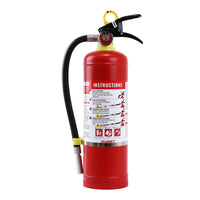
The red Professional 2.5 lb unit pictured is an ABC dry-chemical product example, not an illustration of a universal agent. Its short fixed nozzle, controls and label differ from the hose-equipped units people often picture. Read the instructions for the actual model you own.
Discharge is finite. A light unit is not an unlimited supply, and its weight alone does not tell you every fire it can tackle. Agent, rating, operating distance, user capability and maintenance all matter. Never invent a safe distance from an image.

| Question | Fire blanket | Fire extinguisher |
|---|---|---|
| What must work? | Coverage of a small fire, within the product's allowed uses. | Correct agent and fire-class rating, delivered as directed. |
| Main practical limit | Close approach, limited coverage and possible re-ignition. | Finite discharge; wrong selection or technique can fail. |
| Readiness check | Accessible storage, intact material and understood instructions. | Accessible storage, condition, pressure where applicable and service instructions. |
| What does neither replace? | Smoke alarms, evacuation, calling 911 and a clear escape route. | |
Read the U.S. fire-class label, not just the cylinder color
USFA identifies five primary fire classes. The letters describe the hazard an extinguisher is intended to handle:
- A: ordinary combustibles, including wood, paper and cloth.
- B: flammable and combustible liquids.
- C: energized electrical equipment; the agent must be appropriate for that electrical hazard.
- D: combustible metals, requiring specialized selection.
- K: cooking oils and fats in cooking appliances, commonly addressed by dedicated equipment in commercial kitchens.
ABC does not mean every fire. A familiar multipurpose label does not automatically establish suitability for deep-fat cooking, burning metals or a lithium-ion battery in thermal runaway. This article is not a guide to tackling those specialized hazards.
The numbers before A and B indicate rated extinguishing capacity under standardized tests; they are not a promise that a particular household fire is safe to approach. C identifies electrical suitability rather than a separate numbered fire size. Check the actual label and an independent testing-laboratory listing, not an advertisement alone.
What should you do about a small pan fire?
A third item belongs in this discussion: a metal lid or baking sheet. USFA advises keeping one nearby when cooking. NFPA explains that a small grease fire can be smothered by sliding a lid over the pan, turning off the stovetop and leaving the pan covered until completely cool.
- Only attempt this if the fire is small and contained, the lid can be placed safely, and you have a clear exit.
- Slide the metal lid or baking sheet over the pan. Do not reach through flames.
- Turn off the heat if you can do so safely.
- Leave the pan covered until completely cool. Do not lift the lid to check too soon.
Never add water to burning cooking oil, and never carry a burning pan. If you cannot safely cover it, if the fire spreads, or if you feel unsure, get everyone out and call 911 from outside. For an oven fire, NFPA advises turning off the heat and keeping the door closed.
This is why “blanket versus extinguisher” is not the only decision. A product purchase cannot replace a safe cooking setup, an available lid and attention to the stove.

When should you use neither?
If the fire is growing, smoke threatens you, the exit is compromised, or you are uncertain: get out and stay out. Call 911 from outside. Do not fetch a second tool, return for equipment, or let a purchase create pressure to attempt firefighting.
USFA and NFPA place clear limits on extinguisher use. Only an adult who knows how to operate the unit should consider tackling a small, confined fire. Others should be getting out or already outside; the fire department must have been called or be being called; smoke must not endanger you; and a clear escape route must remain behind you.
The familiar PASS reminder means Pull the pin, Aim at the base, Squeeze the lever and Sweep side to side. It is a memory aid, not a substitute for hands-on training or the manufacturer's model-specific instructions. Teach children to escape and stay out rather than to operate an extinguisher.

Make the equipment you have usable
- Place it for safe access. Follow installation instructions and local advice. NFPA recommends extinguishers close to an exit. Avoid a location that forces you toward a fire to reach the tool.
- Check condition. USFA highlights access, recommended pressure where a gauge is fitted, damage, corrosion and manufacturer maintenance instructions. A gauge alone is not a complete inspection.
- Check the blanket instructions. Know its approved uses, release method, condition requirements and what to do after use. Do not assume every blanket is reusable.
- Plan for the people in the home. Weight, dexterity, mobility and confidence affect whether someone can safely use a tool. Ask the local fire department about training.
The product examples shown are the OUGIST canvas-pouch fire blanket and the Professional 2.5 lb ABC extinguisher. These links identify the pictured products and their current instructions; they do not establish suitability for every scenario discussed here. More educational guides are available in the Knowledge Base.
Frequently asked questions
Can a fire blanket replace a fire extinguisher?
No. A blanket's covering method has different limits from a rated extinguisher. Select equipment for the actual hazards and the people who can safely operate it.
Do I need a blanket if I already have an ABC extinguisher?
Not automatically. A suitable blanket may supplement your plan, but confirm your extinguisher's condition, coverage and safe accessibility first. Local guidance and the blanket's instructions matter.
Are all fire blankets safe for grease fires?
Do not assume so. Materials, size, testing and permitted uses vary. Follow the specific instructions and local fire-service advice. USFA and NFPA provide metal-lid guidance for small pan fires when it is safe to act.
Does a 2.5 lb extinguisher cover every home fire?
No. Size alone is not a fire-class rating. Read the agent, class markings, instructions and independent testing information. No portable unit makes a growing or smoke-filled fire safe to fight.
Should I try a blanket if an extinguisher does not work?
Do not turn the situation into a sequence of experiments. If your attempt fails, conditions worsen or you are uncertain, leave immediately, stay out and call 911.
Sources and further reading
- USFA — Choosing and Using Fire Extinguishers: agents, classes, safe-use conditions and maintenance.
- USFA — Cooking Fire Safety: supervision, heat control, lids and baking sheets.
- NFPA — Fire extinguishers: escape priority, PASS, adult use, training and placement near an exit.
- NFPA — Safety with cooking equipment: covering small grease fires, leaving the cover in place, avoiding water and knowing when to leave.
- Fire blanket — technical overview and reference list: secondary background on covering and oxygen limitation; not an agency endorsement or proof of a particular product's performance.