That Drip Has a Hot Date
A spot under the family car can be harmless condensation, or it can point to a problem that needs service. A photo, color chart, or quick sniff is not a safe diagnosis.
The important question is not “Can I name this liquid?” It is: “Could starting or continuing to drive the vehicle bring an unknown leak near a hot component or another ignition source?”
Do not guess the drip. If something appears abnormal, stop and arrange professional diagnosis before continuing to drive.

Do not diagnose a puddle by color
Vehicle fluids can change color with age, dirt, lighting, pavement, and cross-contamination. Water from air-conditioning can also collect under a vehicle.
That is why a color chart cannot confirm that every trace is fuel—or prove that an unknown trace is safe.
Do not taste or touch the liquid. Do not crawl under the vehicle. Do not open the hood to investigate a suspected leak, especially when there is heat, odor, smoke, or another sign of immediate danger.
Record where the vehicle is parked and describe what you noticed from a safe distance. Let a qualified repair professional identify the source.

If you suspect a fuel leak before starting
Do not start the vehicle. Repeatedly turning the ignition on or trying “just one short drive” is not a useful test.
Keep smoking, open flames, and other ignition sources away. Have occupants move away from the vehicle, then contact roadside assistance or a qualified repair facility.
Ask for towing or service instructions that fit the situation.
Do not try to find, pinch, tape, plug, or clean up the leak yourself. A vehicle with a suspected fuel leak needs professional diagnosis before it returns to service.

If the warning appears while driving
A persistent fuel odor or another obvious abnormal condition while driving deserves immediate attention.
When it is safe to do so:
- Pull over in a safe location away from traffic.
- Shift to Park and switch off the engine.
- Get every occupant out.
- Move everyone away from the vehicle.
- Call roadside assistance or a qualified repair service.
Do not restart the engine to see whether the smell returns. Do not continue driving simply to reach a more convenient repair shop. The vehicle may need professional towing.

Escalate smoke, fire, or immediate danger
If there is smoke, fire, or an immediate threat, do not investigate. Move far away from the vehicle and away from traffic, then call 911.
The U.S. Fire Administration advises people to stay at least 100 feet from a burning vehicle, avoid returning to it, and avoid opening the hood or trunk when fire is suspected.
Follow emergency dispatchers and responders at the scene.
This emergency step is different from diagnosing a parked vehicle. In either case, distance and professional help come before curiosity.
Do not investigate the leak yourself
A suspected leak is not the time to begin roadside diagnosis underneath the vehicle.
- Do not open the hood to investigate a suspected dangerous leak.
- Do not crawl underneath the vehicle.
- Do not touch hot components.
- Do not try to find or plug the leak yourself.
Arrange roadside assistance or professional service instead.

Why leaks and heat matter
The U.S. Fire Administration identifies mechanical or electrical malfunctions and collisions as common vehicle-fire causes and recommends regular professional maintenance.
NFPA highway-vehicle fire data identifies flammable liquids or gases from engines or fuel-burning equipment among the common items first ignited. NFPA also reports especially serious outcomes when a flammable liquid or gas is the first item ignited.
These findings cover highway vehicles as a group and should not be presented as passenger-car-only statistics.
Unknown traces, persistent fuel odor, and other abnormal signs deserve professional service before the vehicle is driven again.
An extinguisher cannot repair a leak
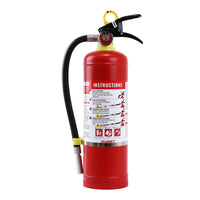
A portable extinguisher cannot identify a liquid, seal a line, cool every hidden hot part, remove vapor, or make a leaking vehicle safe to drive.
Do not keep driving simply because an extinguisher is onboard.
Do not approach a smoking or burning vehicle to retrieve one. Repair controls the leak risk; emergency equipment does not.
Use this order
- Stop and switch off.
- Move occupants away.
- Arrange professional towing or service.
- Call 911 for smoke, fire, or immediate danger.
- Return the vehicle to service only after qualified repair.
- Then review the road kit.

STOP. ENGINE OFF. PEOPLE AWAY.
PROFESSIONAL HELP.
Repair first. Road kit second.
Once the leak has been professionally diagnosed and repaired, emergency equipment can become one part of a broader roadside preparedness plan.
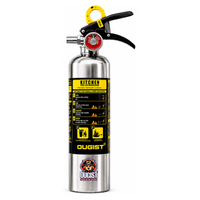
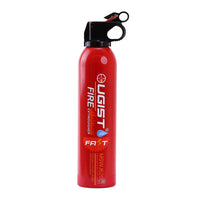
The OUGIST Portable Commuter Car Fire Safety Kit is designed as a compact roadside preparedness kit for commuting, family driving, and road travel.
Important: A portable extinguisher does not identify or repair a leak, replace towing or professional service, or make a leaking vehicle safe to drive.
If the vehicle is smoking or burning, prioritize evacuation, distance, and emergency services.
Check the physical labels and instructions for marked fire classes, storage, inspection, and use limitations before relying on any fire-safety product.
Repair first. Road kit second.
View the Portable Commuter Car Fire Safety Kit →Safety References
U.S. Fire Administration — Vehicle Fire Safety
https://www.usfa.fema.gov/prevention/vehicle-fires/
NFPA — Vehicle Fires
https://www.nfpa.org/education-and-research/research/nfpa-research/fire-statistical-reports/vehicle-fires