The Fire Engine Before Fire Brigades: Ctesibius, Hero and a 2,200-Year-Old Pump
Imagine the alarm going up in ancient Alexandria. There is no siren, no hydrant and certainly no red truck. Yet a crew leans into a wooden beam, two bronze pistons begin to alternate, and a narrow jet of water can be aimed at the flames. The machine looks startlingly familiar because its essential idea still makes sense today.

The short version: Ctesibius of Alexandria developed a twin-cylinder force pump in the third century BCE. Vitruvius later described its valves, pistons and bronze cylinders. Hero of Alexandria preserved a version specifically for fighting fires, complete with a jointed outlet that could direct the stream.
It Began in a Barber Shop, Not a Fire Station
Ctesibius is one of those ancient inventors whose biography arrives in fragments. Vitruvius calls him an Alexandrian and the son of a barber. The charming part of the story is that his path into pneumatics began with a shop mirror.
According to Vitruvius, the young Ctesibius designed a hidden counterweight so the mirror could be raised and lowered. As the weight moved through a pipe, it compressed air and produced a sound. What might have been a clever piece of shop furniture became a lesson: trapped air and moving water could do work.
That curiosity led to water clocks, automata and the hydraulis, a water-powered organ. The surviving texts do not let us watch Ctesibius build the first firefighting pump, but they do show the same mind repeatedly turning pressure, valves and controlled flow into useful machines.

How the Ancient Fire Pump Worked
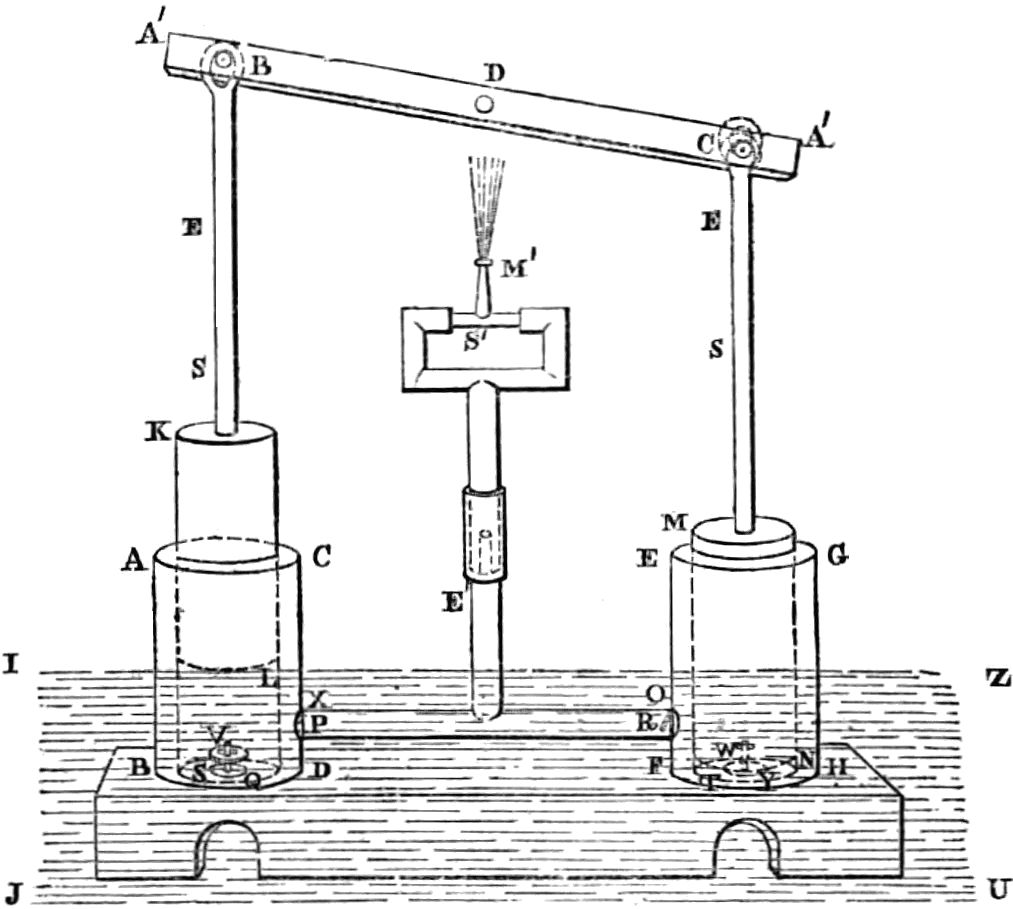
The Kotsanas Museum record describes a twin suction-and-force piston pump intended to maintain a continuing stream. Its two vertical cylinders were immersed in a water tank, probably mounted on wheels. A single pivoted hand lever drove the pistons in opposite directions.
The cleverness was not one spectacular component but the choreography of simple parts:
- One piston rose, drawing water into its cylinder through an inlet valve.
- The other piston fell, forcing water past an outlet valve.
- Non-return valves kept the water moving in the intended direction instead of sloshing backward.
- The two outlet pipes met in a common vertical discharge pipe.
- A rotating nozzle assembly allowed the crew to aim horizontally and vertically.
The two pistons matter because a single piston produces a strongly pulsing delivery: draw, push, pause, repeat. Pairing them so that one refills while the other discharges makes the output steadier. It is an elegant mechanical answer to a very practical question: how do you keep water moving toward a fire when every stroke wants to interrupt the flow?
Vitruvius Gives Us the Pump; Hero Gives Us the Fire Engine
Here the evidence deserves careful wording. In Book X, chapter 7 of De architectura, Vitruvius describes “the pump of Ctesibius”: two bronze cylinders, pistons, valves and converging pipes that raise water. He presents it as a water-raising machine, not explicitly as firefighting equipment.
Hero of Alexandria is the source that closes the gap. Section 27 of his Pneumatics is titled “The Fire-Engine.” It describes two closely fitted bronze cylinders, pistons joined to a rocking beam, outward-opening valves and a discharge arrangement capable of throwing water. In other words, the ancient technical literature does not merely preserve a modern guess that the pump could fight fires; it preserves instructions for a machine intended to do exactly that.
Rome Added Something Harder Than Plumbing: Organization
A pump is not yet a fire service. It still needs water, maintenance, trained hands and people willing to arrive before the roof falls in.
Cassius Dio records that after destructive fires, Augustus organized a corps of freedmen in seven divisions to help protect Rome. The force was retained because its work proved valuable. These night watchmen, the vigiles, combined patrol duties with firefighting and became one of the ancient world's best-known organized responses to urban fire.
Outside Rome, readiness could be much worse. Around 111–113 CE, Pliny the Younger wrote to Emperor Trajan after a fire in Nicomedia. The wind was strong, the inhabitants mostly watched, and the city had neither a public fire pump nor even public buckets. Pliny proposed a 150-man firefighters' guild.
Trajan refused—not because he disliked firefighting, but because he feared that any organized guild might become a political faction. His alternative was wonderfully bureaucratic: provide the equipment, make property owners use it, and press the crowd into service when necessary. Ancient fire safety, it turns out, already involved the familiar triangle of technology, training and public policy.
What the Sources Prove—and What They Do Not
Vitruvius attributes a twin-cylinder force pump to Ctesibius, and Hero explicitly describes a twin-cylinder fire engine.
The complete wheeled tank and nozzle seen in museum displays are modern physical reconstructions based on ancient descriptions.
Modern pumps share principles with the ancient design, but that does not prove a single continuous manufacturing lineage for 2,200 years.
Why This Machine Still Feels Modern
Strip away the bronze, wood and classical names, and the logic is recognizable: a reservoir holds the agent, human power drives a pump, check valves control direction, paired cylinders smooth the delivery, and an aimable outlet puts the stream where it is needed.
That does not make Ctesibius's machine a modern fire truck in miniature. It makes it something more interesting: a reminder that good emergency engineering often begins by breaking a chaotic problem into dependable actions. Fill. Seal. Press. Direct. Repeat.
A modern safety note: do not copy the ancient response by throwing water at every fire. Water can violently spread burning cooking oil and can create an electrical hazard around energized equipment. Match the extinguishing agent to the fire, keep a clear escape route, and leave immediately if the fire grows or smoke increases.

Related modern safety gear
Portable Water-Based Class A/B/C/K Fire Spray with Bracket
From $14.99
Ancient pumps were crew-operated machines. Modern first-response tools are designed to be close at hand. This compact spray includes a mounting bracket for accessible placement.
View productUse only for a small, contained fire when the product label matches the hazard and you have a clear exit. Emergency equipment never replaces evacuation or a call to emergency services.
Sources and Further Reading
- SearchCulture.gr, “The fire pump of Ktesibios and Heron”, record from the Kotsanas Museum of Ancient Greek Technology; description and usage license CC BY-SA 4.0.
- Kotsanas Museum digital collection, exhibit 106043, fire-pump reconstruction and collection description.
- Vitruvius, The Ten Books on Architecture, Book IX, chapter 8 (Ctesibius and the barber-shop mirror), and Book X, chapter 7 (the pump of Ctesibius), translated by Morris Hicky Morgan.
- Hero of Alexandria, The Pneumatics, section 27, “The Fire-Engine”, edited and translated by Bennet Woodcroft (1851).
- Pliny the Younger, Letters 10.33–34, the Nicomedia fire and Trajan's reply.
- Cassius Dio, Roman History 55.26.4–5, on Augustus's seven divisions of night watchmen.
Image Credits
- Fire-pump reconstruction: Kotsanas Museum / Costas Kotsanas, via SearchCulture.gr, CC BY-SA 4.0.
- Hydraulis reconstruction: Aga39memnon, Wikimedia Commons, CC BY 4.0.
- Hero fire-engine diagram: Bennet Woodcroft edition (1851), public domain, via Project Gutenberg.